


As I've been building content for the Swim Mindset Collective, I keep discovering different insights that shape how I think about mindset in swimming . Here's something that occurred to me while working on the Championship Meet Map this week.
While I was looking at the map something stood out to me visually - everyone thinks about mindset while racing, but when you look at the map you see that racing is actually a small part of the overall meet experience.
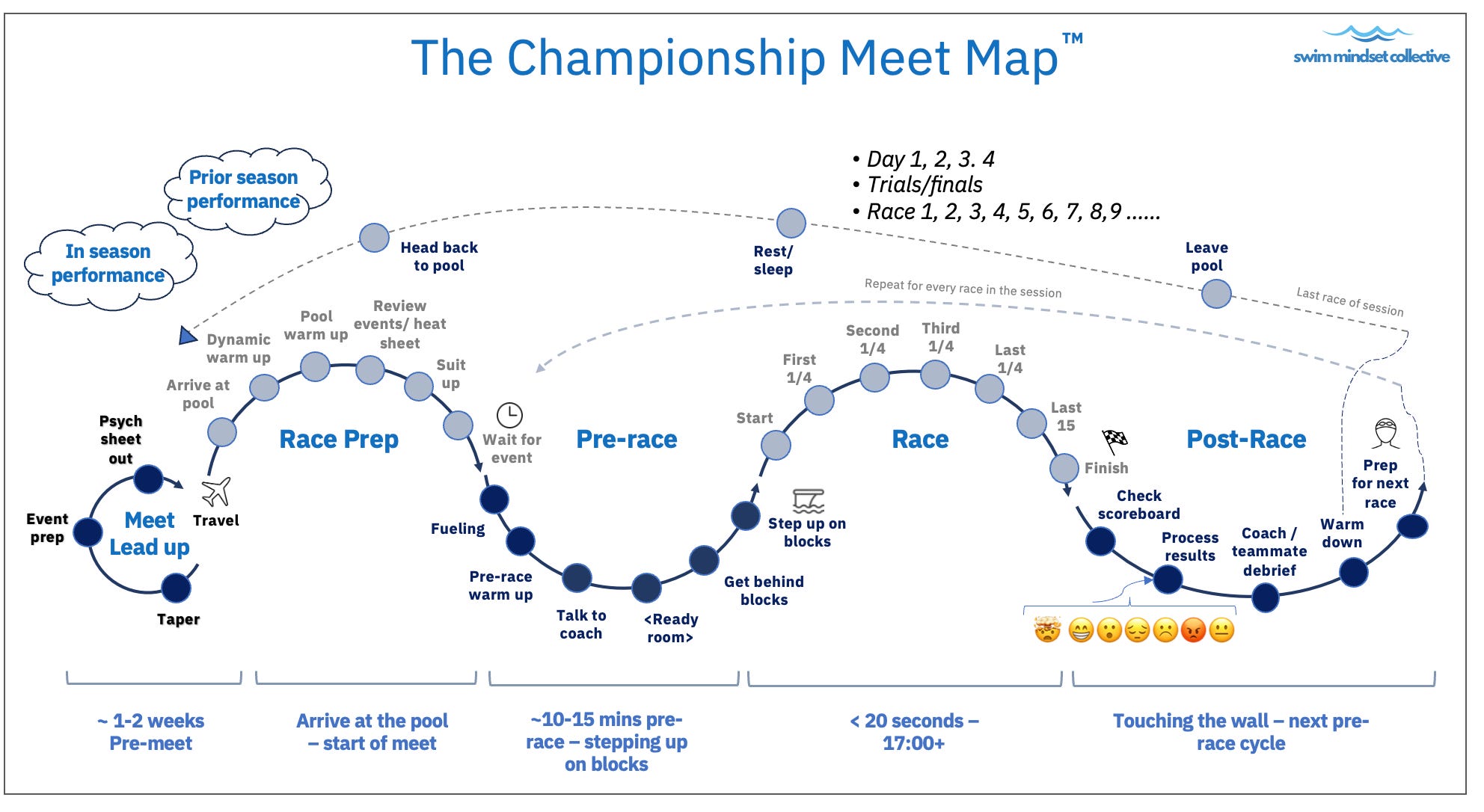
So then I started doing some math. A 3½-day championship meet lasts about 5,040 minutes from start to finish. That includes everything: travel back and forth from the pool, warm-ups, waiting for events, prelims, finals, recovery, team meetings, meals and everything in between.
So how much of that time does a swimmer actually spend racing?
Less than 1%.
That’s true even if you’re swimming distance events and racing prelims and finals every day. Racing make up a tiny fraction of the meet - but 100% of the outcome.
Why is this interesting? Because performance is influenced by everything that happens before you step behind the blocks. Every one of those 5,040 minutes has the potential to affect attention, execution, and ultimately performance. Those surrounding minutes aren’t just time between races. They are where mindset is either built up or worn down before you ever hit the water.
That’s exactly what the Championship Meet Map helps swimmers see.
How the Championship Meet Map changes the conversation
The Championship Meet Map can look busy but the goal of the map isn’t to add complexity - it’s to create clarity. The map breaks a championship meet into individual moments a swimmer can actually prepare for.
Without the map, championship meets can feel overwhelming. Once a swimmer sees it laid out visually, they can pinpoint the specific moments that challenge them.
Instead of being overwhelmed they start saying things like:
“Actually, I’m fine through most of the meet. I really struggle between trials and finals.”
Or:
“Warm-up is where I start getting inside my own head.”
Now they don’t have a vague mindset problem - they have a specific moment they can train. That’s what I like about the map — it turns an overwhelming experience into a series of manageable moments.
Building the Swim Mindset Collective
One of my goals with this series is to share not only what I’m building, but also some of the thinking behind it.
Sometimes it's a framework I'm developing. Sometimes it's a question I'm wrestling with. And sometimes it's a simple observation like this one that helps me see championship performance a little differently.
I welcome your thoughts and feedback.