


I’ve been around Substack for a while now, and one of the things I’ve enjoyed most is reading posts from swim coaches discussing their training philosophies and how they build their programs. I’ve been impressed by the amount of thought that goes into each training block and each practice. Truthfully, I think few swimmers fully appreciate how each set and each rep fits into a larger plan to help them perform at their best.
It’s clear that coaches care deeply about their swimmers’ performance and are constantly looking for ways to help them improve. What are the top coaches doing? What does the latest science say about training load, recovery and nutrition? All season long, coaches build their swimmers’ capacity, tweaking and refining as they go.
But there’s one set that usually doesn’t get the same attention: mindset. It’s the yardage (or meters, depending on where you swim) that most teams still aren’t doing.
In this post, I want to make the case for two things:
Why mindset training matters
Why it belongs to the team, not the individual
Why mindset training matters
Let’s start with some things every coach has probably seen. The swimmer who puts in the work all season but seems to “choke” at the championship meet. The swimmer who seems to have it all together but suddenly panics when a competitor starts to pull ahead. The swimmer who backs off when a race feels harder than expected, or who can’t seem to perform unless meet conditions are “perfect”.
These situations are frustrating because the coach knows the capacity is there. The swimmer has done the work all season. However, they struggle to access what they’ve built when it matters.
I can’t promise a coach that implementing a mindset training program will improve every swimmer’s times by a particular percentage. Performance is influenced by many factors, mindset among them. What I can say is that mindset deserves attention because physical capacity alone doesn’t guarantee that a swimmer will be able to perform to their potential in competition. Mindset training is the piece that helps ensure that swimmers can access what they’ve trained when it matters most.
Physical training builds capacity.
Mindset training helps swimmers access it.
When mindset training becomes an intentional part of training instead of the set everyone skips, more swimmers access their capacity more consistently. That alone is reason enough not to ignore it.
Why mindset training belongs to the team
There are some programs that have made a significant investment in mental performance support. I’ve written previously about two USA Swimming teams in Texas that hired directors of mental performance. These are encouraging examples, but dedicated support of this kind isn’t available to every program.
For many swimmers, getting mindset support follows a different path. Here’s what that often looks like:
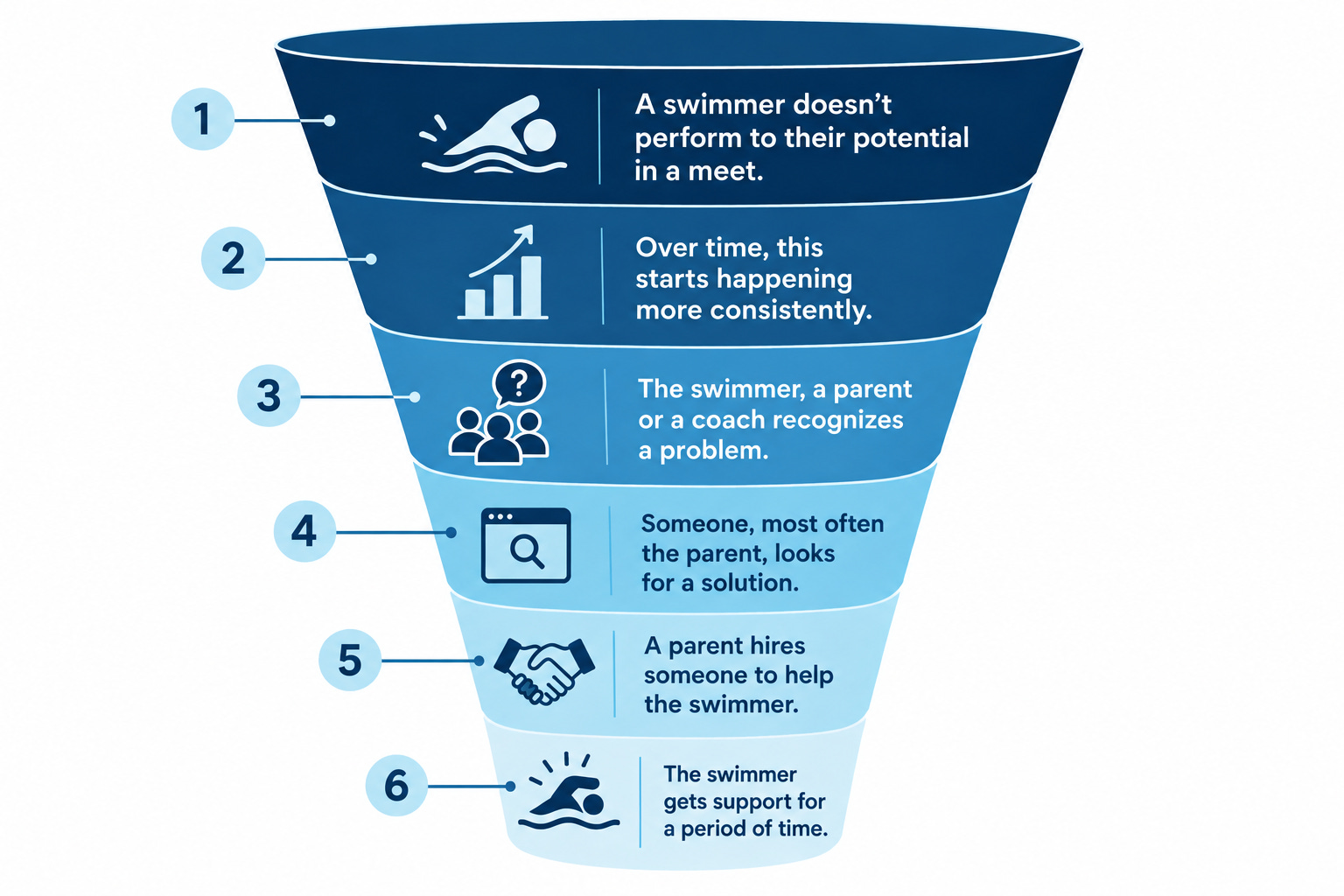
It typically starts with a swimmer having a meet where things don’t go well. One disappointing meet becomes a pattern. The swimmer may start to wonder whether something is “wrong”. A coach or parent may also begin to worry.
Eventually, someone looks for a solution to help the swimmer with mindset. Most often, that’s a parent. They may ask the coach for a recommendation, but the parent usually has to find the right person, decide whether the support is a good fit and determine whether the family can afford it.
If they find the right person and can make the investment, the swimmer may receive support for a defined period of time—anywhere from a few weeks to a few months.
There are several limitations to this model.
First, its reactive and not proactive – it only starts after a swimmer is struggling. Second, swimmers can drop out at every step of the funnel meaning very few actually end up getting any sort of support. Third, finding support can be tricky, time-consuming, and expensive. Finally, even if the parent finds the right person and has the resources to pay, the swimmer may be reluctant to participate. They may worry that seeking help means they are not “mentally strong.”
The result is that while I believe every swimmer can benefit from mindset training, only a tiny percentage ever get any version of it.
A better way
I believe there’s a better way: make mindset training an integral part of a team’s training program.
Instead of leaving it up to each family to seek out support once a swimmer is struggling, mindset training becomes part of the program and is available to every swimmer. This doesn’t mean adding another thing to a coach’s plate. It doesn’t have to take pool time, and coaches don’t have to become mindset experts. Short, regular lessons swimmers take in on their own time (in the car on the way to practice, before bed) can build the skill the same way regular sets build fitness. The result? Swimmers access more of their capacity, and mindset training stops being something for the “weak.” It becomes something more like strength training, which builds muscle in every swimmer.
When mindset training becomes a regular part of the program, something else changes too: the culture of the team.
When it’s a regular part of training, swimmers have more opportunities to discuss what they’re experiencing, share what they’re learning and support one another. Swimmers begin to understand that mindset matters. The collective gets stronger.
This doesn’t mean individual support isn’t valuable. Some swimmers will still benefit from working one-on-one with a qualified professional. But that doesn’t have to be the only way swimmers receive help with mindset.
What if mindset training were part of preparing for competition all season long, available to all swimmers, rather than something a swimmer seeks out only after things go wrong? That’s the idea behind the Swim Mindset Collective: a practical, season-long approach to making mindset an integral part of training.
If you’re a coach and you’re curious about how consistently your swimmers perform to their potential at meets, I’d like to invite you to a free Championship Performance Audit.
In this 30-minute conversation, we’ll explore six areas of championship performance, from how swimmers respond when races don’t go to plan to how much attention your program gives to this part of training. We’ll look at where you see strengths, where you see gaps, and what opportunities there may be to do more.