
Fear and pressure get talked about like they’re the same thing.
They’re not.
Here’s a story that shows the difference. One swimmer was anchoring a relay at a championship meet. The moment she dove in, she felt like she’d just taken off her paddles. Her hands suddenly felt too small — like she couldn’t catch any water.
That’s pressure.
Fear feels different.
Fear sounds like:
What if I die during the last 50?
What if my training doesn’t pay off?
What if I get DQed?
What if I embarrass myself?
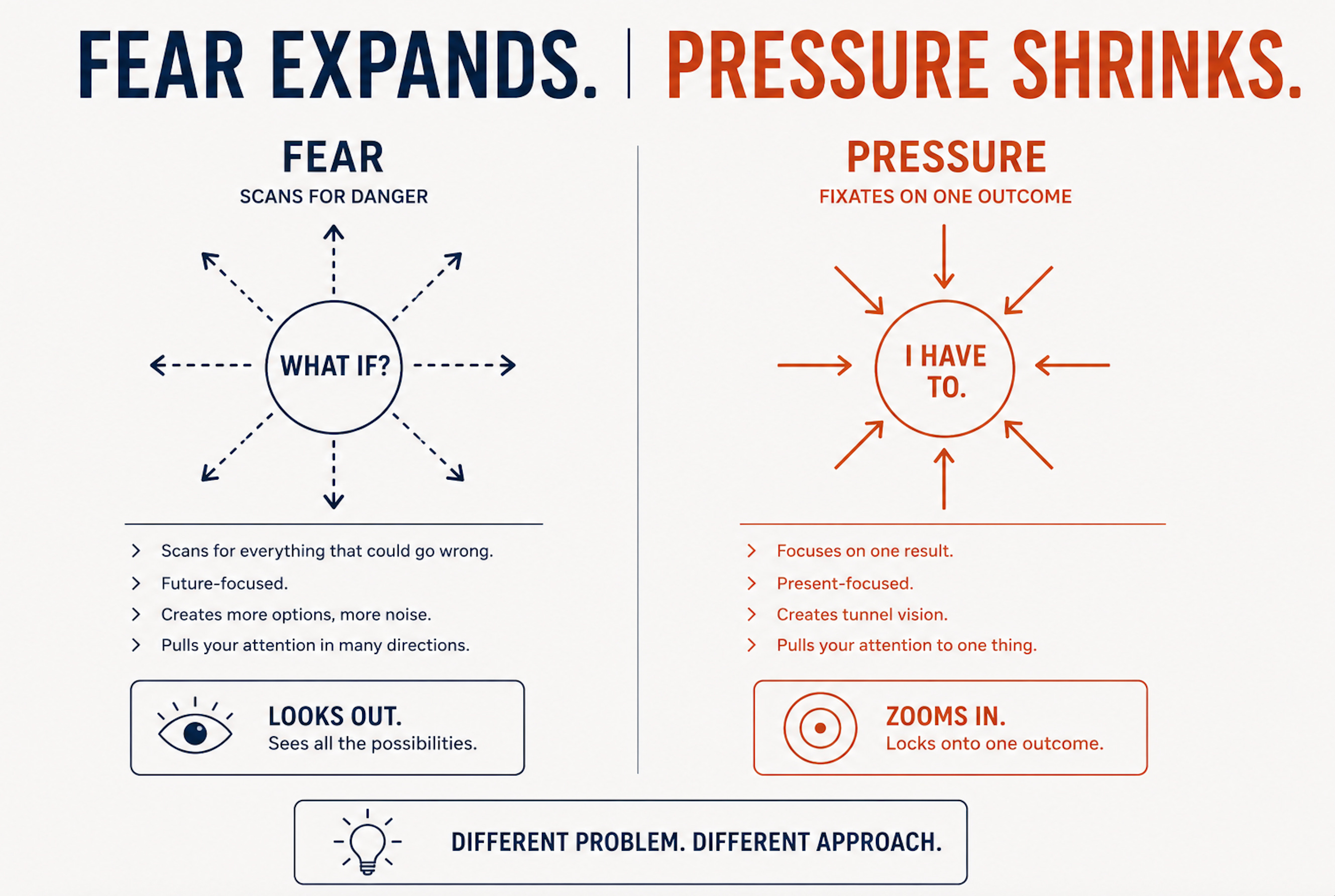
Your mind starts scanning for everything that could go wrong.
Pressure doesn’t scan. It fixates — on one outcome you feel like you have to produce:
I have to make the cut.
I have to win.
I have to get a PB.
Here’s the simplest way I’ve found to describe the difference:
Fear expands. Pressure shrinks.
They often show up together, which is exactly why they’re easy to confuse. A swimmer standing behind the blocks might be scanning for danger and fixating on one outcome, both at once, and it just feels like a jumble of “I’m freaking out.”
That’s normal.
The skill isn’t feeling one cleanly instead of the other — it’s learning to notice which one has the wheel in a given moment, because they pull you in different directions.
When fear takes over, a swimmer often goes into protection mode — playing it safe, abandoning the plan they trained. When pressure takes over, it’s the opposite: swimmers tighten up, rush their stroke, over-try. What should be automatic becomes forced.
One thing I’ve been realizing while building the Swim Mindset Collective is that we often jump straight to solutions before we’ve named the problem. But you can’t pick the right tool for a jumble. You have to know whether what’s showing up is fear or pressure.
Different problem. Different approach.