

December 1983.
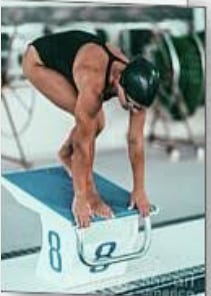
I was aiming for my first Junior Nationals cut in the 1650 freestyle. At my last meet, I had missed the cut by just a few tenths.
As I stood on the blocks, I felt the normal pre-race nerves, but surprisingly little fear. Or pressure. I wasn’t thinking, “I have to make this cut.” For some reason, I knew I was going to.
And I did.
Over the next several years, I’d have some moments like that where everything just seemed to fall into place—and others where my mindset seemed to betray me. It felt random and hard to grasp, and that was frustrating.
How could I summon that invincible feeling I’d had during the 1650?
Determined to figure things out, I read the few books that existed on psychology for swimmers back then. I created my own personal “psych journal.” I even ended up majoring in psychology in college.
I finished my swimming career believing firmly that mindset played a huge role in performance, but never quite figuring out my own personal mindset formula—the combination of tools and strategies that allowed me to consistently perform at my best.
Fast forward several decades and my own daughter was now the swimmer.
As she got into her teens, it seemed to me she could use some support with her mindset. So I started looking around for resources.
Surely, decades later, this was readily available to swimmers?
To my surprise, it wasn’t.
We had social media, online courses, many more books, and sports psychologists working one-on-one with swimmers. But where was the actual training?
My busy teenager wasn’t going to read a 300-page book, take detailed notes, and figure out how to apply it in the pool.
She wasn’t going to sit through a four- or five-hour online course and then remember everything at exactly the right time.
Social media was great for temporary inspiration, but I wasn’t convinced it would hold up under pressure.
I set her up with a sports psychologist and quickly spent thousands of dollars. The psychologist had all the credentials, but she didn’t understand swimming, and it wasn’t clear to me that my daughter was actually getting anything out of the sessions.
That’s when I decided I needed to figure things out on my own.
Over the course of several years, I started reading, researching, and putting together some of my own ideas and frameworks. Eventually, I left my corporate job at IBM to devote myself to building this full time.
I wanted to create something truly different.
First, it had to be built specifically for swimming.
Swimming has its own unique mindset challenges. Most important is that swimmers race in a literal bubble. Unlike most other sports, swimmers never have a true idea of how they are performing until they touch the wall and look up at the clock—and that has all sorts of implications for mindset.
Swimming is an endurance sport that is also highly technical, meaning swimmers have to maintain technique under pressure. Then there is the large variety of events—from a 50 to a 1650—each requiring different mindset approaches. And finally, there is the championship meet format itself.
With all these factors, generic mindset approaches just aren’t effective.
Second, it had to be simple enough to actually use.
Swimmers are already busy. I wanted ideas to be taught in small, manageable pieces that could fit into the lives and training schedules they already have.
Third, it had to be actionable.
I didn’t want this to be a collection of interesting concepts that swimmers could understand but never actually use. The point is to learn something, try it, see what happens, and use that experience to keep getting better.
Fourth, it had to recognize that every swimmer is different.
There isn’t one mindset strategy that works for everyone. Each swimmer needs to understand what works for them and develop their own approach.
And finally, I didn’t want mindset training to be something you did once and then forgot about. It needed to be something swimmers could develop over time, alongside the rest of their training
So that’s what I built.
The Swim Mindset Collective is not a static course—it is a season-long mindset training program for competitive swimmers.
It includes foundational modules that introduce the key frameworks I’ve developed over the past year, ongoing short-form lessons through a private podcast called The Missing Set, and a Formula 4 One™ workbook where swimmers capture what they’re learning, experiment with different tools and strategies, and gradually develop their own personal approach.
The goal isn’t to add another big thing to a swimmer’s already busy schedule. It’s to make mindset something they can actually train—just like every other aspect of their swimming.
Today, I’m formally launching the Swim Mindset Collective Founding Member Program.
The initial cohort will be limited in size so I can incorporate member feedback and shape the program with the founding group.
I’m proud of what I’ve built, and I’m excited to finally put it into the hands of swimmers.
Learn more and join → Swim Mindset Collective Found Member Program