


In my last article, I made the case that swimming requires a swim-specific approach to mindset training. The mental demands of our sport are unique, and generic advice often misses the reality swimmers face when it matters most.
Today I want to take that idea one step further by examining the environment where swimmers are asked to perform at their best: the championship meet.
A lot of conversations about mindset in swimming focus on a single moment — the seconds behind the blocks before a race. But any coach or swimmer who has spent time on a championship pool deck knows performance is shaped long before that moment arrives.
A championship meet is not defined by a single moment -- it is a complex environment that swimmers must navigate across several days of racing. To make that clearer, I developed a framework I call The Championship Meet Map™.
The map illustrates the environment swimmers move through during a championship meet and highlights the many moments that can influence an athlete’s mindset and performance.
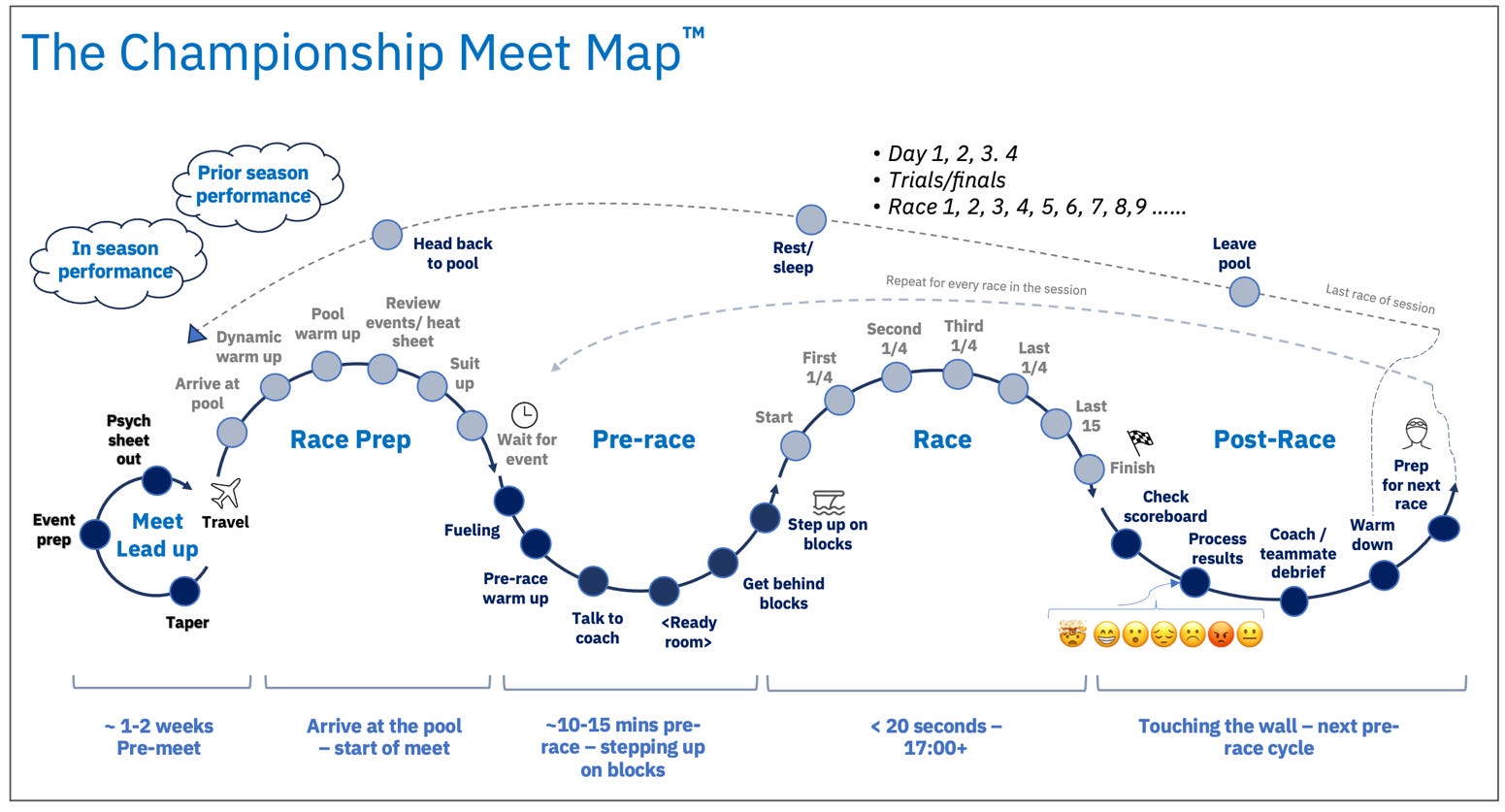
At first glance, the map may look busy. That’s intentional.
Championship meets are complex environments and swimmers must navigate changing conditions, emotions, expectations, and decisions across multiple days of racing. The goal of this map is not to simplify that environment, but to make it visible.
When you step back and look at the map, one thing becomes clear very quickly:
The race itself occupies only a small portion of the championship meet environment.
There are many mindset moments swimmers must navigate in the lead up before the race and after the race and the whole cycle can happen 5, 10 or even 15 or more times during a championship meet. Let’s walk through the key regions of the map.
The Backdrop: What the Swimmer Brings to the Meet
Before the meet even begins, swimmers arrive carrying a narrative about themselves and their season.
Have they been swimming best times all year or has it been a frustrating season filled with near misses? Do they typically perform well at championship meets — or do they struggle when the stakes rise?
All of that history becomes the backdrop against which the meet unfolds. Long before the swimmer steps onto the pool deck, their mindset has already been shaped by their past experiences and expectations.
Meet Lead-Up: When the Meet Starts to Feel Real
One to two weeks before the meet, attention begins to shift. Taper begins. The water starts to feel different. Training shifts from heavy work to sharpening race details.
Coaches begin talking about pacing, strategy, and race execution.
Then the psych sheet drops. For many swimmers, this moment carries more weight than people realize. Seeing their seed times, competitors, and heat placements can trigger excitement, confidence, doubt, or comparison.
Championship meets often involve travel which can be challenging and unpredictable. Was the travel seamless or did flight delays result in a 3 a.m arrival?
Race Preparation: The Environment on Deck
Any travel issues aside, the swimmer eventually arrives at the pool.
They warm up. They check the heat sheet again. They talk with teammates and coaches. They begin putting on their tech suit. During this time, a surprising number of variables can influence mindset.
Is the pool familiar or unfamiliar?
Did warm-up feel good or strangely flat?
How crowded is the warm-up lane?
Are they in what they perceive to be a “good” heat?
How long will they have between events?
Did their tech suit rip at the worst possible moment?
Each of these factors may seem small in isolation. But together they create a cognitive load that swimmers must manage before they ever reach the blocks.
The Pre-Race Window
Eventually the meet session begins.
The first event is called, and the swimmer enters what I think of as the pre-race window — the period between the start of the session and the moment they step onto the blocks. Depending on the event order, this window could last five minutes or several hours.
As the race approaches, preparation becomes more focused. About 10–15 minutes before racing, swimmers begin their final routines. They may fuel, do a short secondary warm-up, talk with their coach, or head to the ready room if the meet requires one.
This phase ends when the swimmer steps onto the blocks.
Race Execution
Now we arrive at the moment most people associate with mindset: the race itself.
I often think about races in segments. Regardless of length, each race can be divided into quarters, followed by the last 15 yards/meters and the finish.
In every event, swimmers must manage several demands simultaneously:
execution of technique
pacing decisions
increasing fatigue
maintaining focus
committing to the finish
These demands look very different depending on the event. The mental demands of a 50 are very different from those of a 400 IM or a 1,650. The better a swimmer understands and prepares for the unique demands of their particular race, the more successful they will be.
Post-Race Processing
After the swimmer touches the wall, they look up at the scoreboard and instantly process their results.
Relief.
Excitement.
Frustration.
Disappointment.
Any experienced coach has seen the full spectrum of reactions play out in that moment.
The swimmer climbs out of the pool, speaks with teammates and/or coaches, warms down and begins the process of resetting mentally.
And then something important happens - they do it all again.
Unlike many sports, swimmers often repeat this entire cycle multiple times in a single day. Over the course of a championship meet weekend, a swimmer might race anywhere from six to eighteen times, including relays.
That means this entire sequence — preparation, racing, emotional processing, and reset — repeats over and over again.
Why This Matters for Mindset Training
So what is the point of mapping the meet this way?
If mindset training is going to be effective for swimmers, it needs to reflect the environment in which swimmers actually compete.
Championship meets are not defined by a single moment behind the blocks. They are defined by dozens of moments that unfold across days of racing — moments where expectations, emotions, distractions, and decisions all interact.
When swimmers learn how to navigate those moments effectively, mindset becomes more than motivational advice. It becomes a practical performance skill.
What do you think?
From your perspective as a coach, parent or swimmer does this map match your experience of the championship meet?
I’d love to hear your thoughts.