


This summer at Pan Pacs, Summer McIntosh, world record holder in the 400 free, finished ninth in prelims and missed the A final.
If you’ve watched Summer race, you know her reaction is written all over her face the moment she touches the wall. Excited, satisfied, disappointed — whatever it is, it’s right there. This time it was disappointment.
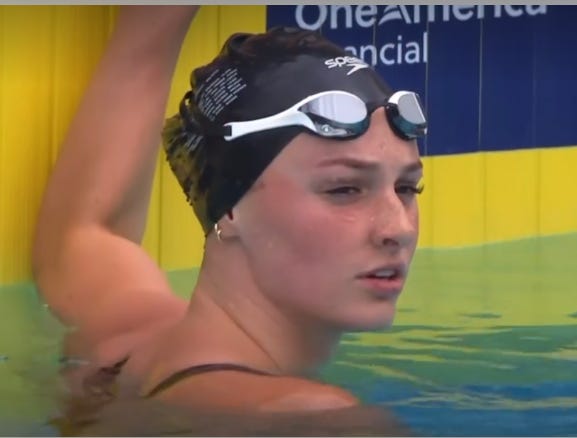
A few hours later, she posted: “I take full responsibility for my misjudgment in this morning’s heats… I will see you all in the B final tonight.” That night, she swam the B final, putting up a respectable 4:00.58. In a post-race interview, she said this about her morning swim: “Honestly, I just kind of wiped it out of my mind.”
She was able to wipe the morning swim out of her mind enough to put together a decent finals swim but that doesn’t mean she completely forgot about it. In an recent interview with Katie Hoff on Unfiltered Waters, Summer described how, after her disappointing performance at Pan Pacs, she stayed up until 3 a.m. brainstorming everything she wanted to improve — from weights and dryland to turns, dives and having a protein shake after every practice.
That’s responding instead of reacting.
It’s being able to let go of the emotional reaction to a performance in the moment, refocus on what comes next, and continue competing — while still learning from what happened.
And it’s a skill your swimmers can learn.
Why responding matters at championship meets
Every coach knows the moment. The championship meet arrives. Your swimmers are tapered, shaved and suited. They’ve worked hard all season, and now is the time for everything to fall into place.
Then the first races happen. Some swimmers swim out of their minds. Some do “ok.” Others fall short of expectations — yours or their own. What happens next matters.
A great swim can leave a swimmer riding high. A disappointing one can send them spiraling. An “ok” swim can leave them questioning what it means. In each case, the emotional reaction can take up so much mental space that the swimmer loses focus on what comes next.
We are not trying to stop swimmers from feeling excited, disappointed or frustrated. Those reactions are natural, especially at a championship meet. The goal is to help them recognize those emotions, let them go in the moment, and choose where to direct their attention next.
That’s the difference between reacting and responding.
Reacting is emotional and often automatic.
Responding is analytical and deliberate.
At a championship meet, which path the swimmer follows can make all the difference.
What responding versus reacting looks like
No matter whether the swim is great, disappointing or just so-so, there are big differences in what a swimmer does when they react vs. respond.
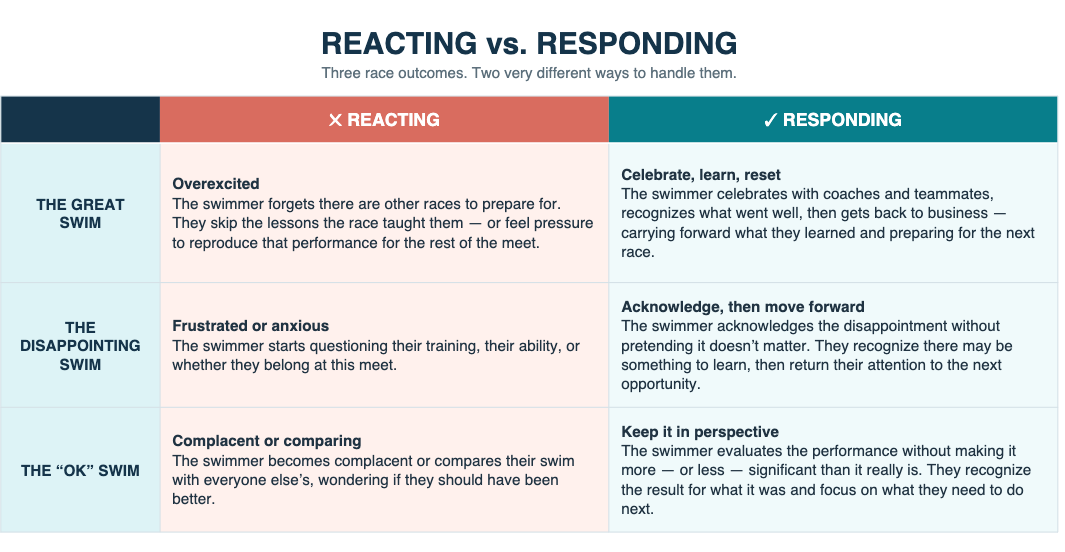
In all three cases, the principle is the same: the swimmer doesn’t have to control their initial reaction. They just need to learn how to respond to it.
How can coaches teach swimmers to respond instead of react?
Responding instead of reacting is a skill swimmers need to learn and practice. Coaches play an important role in teaching that skill, but the goal isn’t for a coach to manage every swimmer’s reaction after every race.
At a championship meet, a coach may have dozens of swimmers competing across multiple events. They can’t be responsible for helping every swimmer process every result and reset for every race. More importantly, if swimmers are going to become independent competitors, they need to learn how to do this for themselves.
That starts with teaching them three steps:
Notice the reaction.
Put it in a box.
Choose what comes next.
1. Notice the reaction
Swimmers need to learn to recognize what’s happening when they get out of the pool. Are they beating themselves up? Getting carried away by a great result? Comparing themselves to a teammate? Worrying about what a swim means for the rest of the meet?
The first step is simply becoming aware of those reactions and recognizing when their thoughts and emotions are pulling their attention away from what comes next.
Coaches can introduce this skill in practice, in post-race conversations and when reviewing meet experiences. The aim is to help swimmers recognize their own patterns, not to tell them how they should feel.
2. Put it in a box
Once swimmers recognize their reaction, they can learn to acknowledge it and then put it aside.
“Putting a swim in a box” means letting go of the emotional reaction to the result so the swimmer can move forward. It’s not about pretending the swim didn’t happen, that it doesn’t matter or that there are not lessons to learn. It’s about acknowledging the emotions and shifting attention to what comes next. The lessons from the swim can be extracted without continuing to replay the race or carry its emotional weight into the next one.
Most swimmers will need to learn specific strategies to put a previous performance aside and refocus on what comes next. Here are three techniques to try:
Attentional control
When a swimmer notices their thoughts drifting back to a previous race — replaying a mistake, dwelling on a disappointing time, or thinking about how well they swam — they can consciously redirect their attention to the next race. This might mean focusing on the pacing strategy for their upcoming race, identifying one thing they want to execute, or thinking about what they need to do to prepare.
The goal is to recognize when their attention has wandered and choose where to direct it.
Tapping
Tapping, also known as Emotional Freedom Techniques (EFT), combines tapping on specific points on the body with focused attention on thoughts and emotions. A substantial body of research, including randomized controlled trials and meta-analyses, has examined EFT and found evidence of benefits for anxiety, psychological stress and sports performance.
Swimmers can learn a simple tapping routine to try when they feel distracted or emotionally wound up after a race. Practiced in advance, it gives them another tool they can use independently, whether poolside, in the locker room, or back in their hotel room.
Visual erasure
Swimmers can use visualization to create a mental signal that a race is finished. For example, they might picture putting the race in a box and locking it, or writing the event on a whiteboard and then erasing it. The image serves as a reminder that the race has happened, they can return to it later, and their attention can now shift to what’s next.
Swimmers should experiment with these and other techniques to discover what works best for them. The goal is to build a set of strategies they can use on their own, without needing their coach to help them reset after every race.
3. Choose what comes next
The final step is deciding what they need to do now.
That might mean reviewing the plan for their next race, making adjustments on technique or race strategy, or simply getting on with their warm-down and recovery. The right next step depends on the swimmer and the situation. The important thing is that the swimmer makes a deliberate choice to respond rather than carrying their immediate emotional reaction with them.
Coaches can help swimmers develop this habit, but the ultimate goal is for athletes to recognize what they need and take responsibility for their own preparation.
Questions swimmers can learn to ask themselves
Coaches can use questions like these to introduce and reinforce the process. Over time, swimmers can learn to ask themselves the same questions without needing a coach to prompt them.
Notice the reaction
What am I telling myself about that swim?
What’s taking up most of my attention right now?
Put it in a box
Can I accept that this is how the swim went and focus on what comes next?
What strategies can I try if I can’t get my mind off the swim?
Choose what comes next
What’s my job between now and my next race?
What do I want to focus on when I get behind the blocks again?
What can I do right now that will help me be ready?
Remember: we don’t want athletes to suppress those emotions. We want them to learn how to work with them. A swimmer can feel disappointed and still respond well. They can be excited without losing focus. They can be frustrated and still make a thoughtful decision about their next race.
Processing results is just one part of the Championship Meet
Championship meets matter. Swimmers have invested months of hard work, and it’s natural to feel excited, disappointed or frustrated when the results come in. Processing results is just one moment during the meet but a very important one.
I mapped out the entire championship meet experience in the Championship Meet Map™. It helps coaches and swimmers understand the moments that shape championship performance, including how swimmers respond to one race before moving on to the next.
If you’d like to explore how your team’s mindset affects performance at championship meets, I’m offering a free Championship Performance Audit. Learn more here: Championship Performance Audit.