



Championship meets are complicated environments. Swimmers move through taper, travel, warm up, waiting, racing, recovery, prelims, finals and everything in between. That was part of what led me to build the Championship Meet Map. The goal was simple: make something that often feels chaotic easier to understand.
The map helps swimmers better understand the championship meet, but it cannot capture everything they encounter along the way. Think of a championship meet like a long road trip. During the drive, conditions change and obstacles arise – traffic, construction, weather, unexpected detours. Championship meets work the same way, just with a different set of obstacles – crowded warm up lanes, unfamiliar food, noisy hotels, long waits between events, ripped tech suits, unexpected race dynamics. Some are predictable. Some are not.
Just like two drivers can react differently to road conditions, different swimmers can react differently to what they encounter during a championship meet. The four challenges grew out of that observation.
The Four Challenges of Championship Meets
As I observed how swimmers responded while navigating championship meets, I identified four broad patterns:
They get caught up in predicting the future
They try to force a specific result
They get distracted by everything happening around them
They start reacting to the physical intensity of racing
These patterns became the four challenges of the championship meet – fear, pressure, disruption and discomfort.
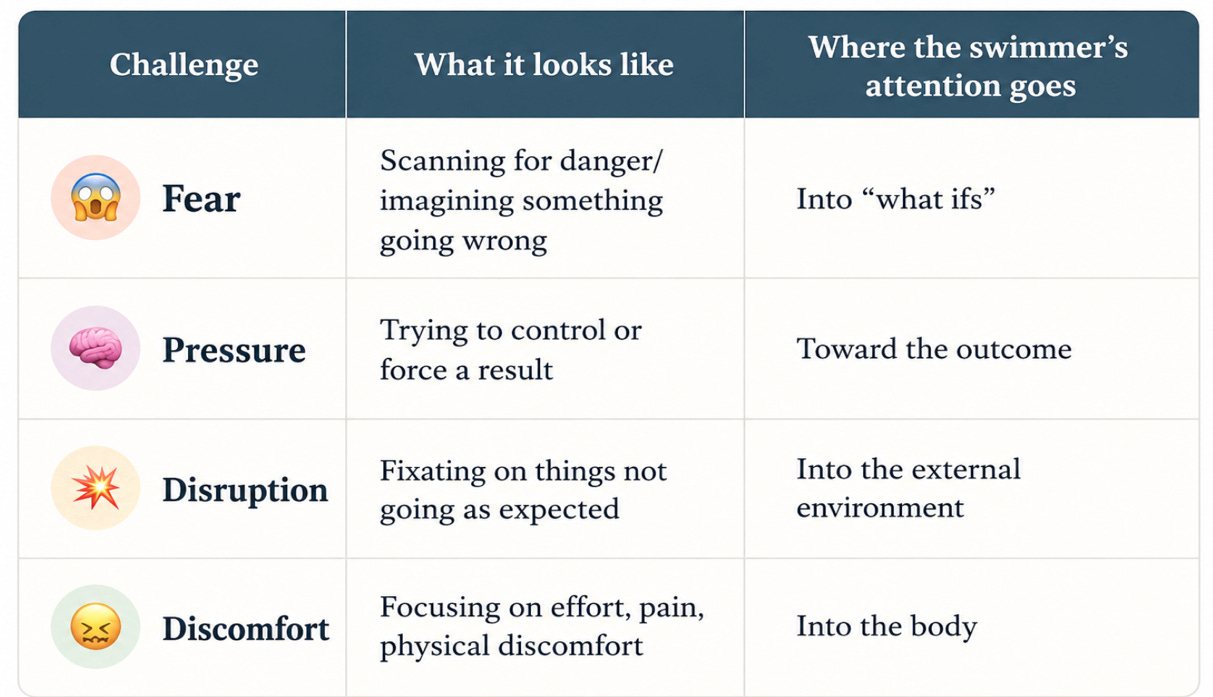
These challenges tend to become more pronounced in championship meets, where uncertainty is amplified and outcomes carry more weight. Swimmers never fully know how a race will unfold, how they will feel, how others will perform or whether they will be able to execute when it matters most. Uncertainty itself is not the challenge. It’s when swimmers try to remove, escape, predict or otherwise control uncertainty that the challenges arise.
Recognizing these common challenge patterns changes everything. Instead of assuming something is wrong with them, swimmers can see challenges as predictable parts of the championship meet environment. This allows swimmers to develop effective responses tuned to the specific challenge that shows up for them.
Let’s explore each in more detail.
Fear
In championship meets, fear shows up when the mind starts trying to predict or solve the future. Fear tends to pull attention into a series of what ifs:
“What if my training doesn’t pay off?”
“What if I can’t keep up?”
“What if I don’t get a PB?”
Fear can hit a swimmer at various times during a championship meet: the night before a race, between trials and finals, in warm up or behind the blocks. Fear can affect sleep, appetite, the ability to stay calm or to focus.
Fear is why a swimmer can’t sleep, eat or feels mentally drained before they even get to the pool.
Pressure
In swimming pressure is about meaning - it’s when something is important to the swimmer and they try to control the result. When pressure shows up, the swimmer’s attention is pulled towards the outcome:
“This counts.”
“I have to get the cut.”
“I have to win.”
Pressure tends to show more loudly closer to the race. When it does, swimmers may tighten up, rush their stroke, lose rhythm or over try. Things that should be automatic become forced, often leading to sub optimal performance.
Disruption
Disruption happens when the environment doesn’t match expectation. When this happens, attention gets pulled outward.
With multiple days of racing, trials/finals, dozens of events and hundreds of swimmers and heats, it’s rare for championship meets to go off without a glitch. Swimmers can get disrupted by many things – a bad warm up, meet delays, a competitor in an early heat dropping a huge PB - before they even dive in the water. During the race itself, unexpected race dynamics can also become disruptive. For example, a competitor going out faster than expected or a swimmer feeling “off” from the first 50.
Disruption can cause swimmers to decide they can’t swim well before they even step on the blocks or to abandon a race plan when a swim doesn’t go as expected.
Discomfort
In swimming, discomfort comes from the physical intensity of racing – the body’s natural response to working at high effort. It shows up as burning arms, heavy legs and lungs on fire. It’s uncomfortable, but it’s normal. It’s part of the sport.
The challenge arises when a swimmer develops a negative attitude towards discomfort and fixates on the uncomfortable sensations in their body:
“This hurts too much”
“I’m dying”
“I can’t hold this pace”
When the swimmer’s attention goes into the body, perception of effort increases making the race feel more difficult. A swimmer may “blow up” and fall off pace even though physiologically they still have more available.
Why the Attention Pattern Matters
What makes this framework useful is that each challenge has a very distinct pattern:
Fear pulls attention into “what ifs”
Pressure pulls attention toward the outcome
Disruption pulls attention into the environment
Discomfort pulls attention into the body
Swimmers do not need to become experts in psychology to use this. They simply need enough awareness to recognize where their attention went. That recognition alone can help swimmers better understand the challenge they are dealing with and how it is affecting performance.
Once they have this clarity, swimmers can develop specific strategies for dealing with the challenge they are facing in the specific moment they face it. In my work with swimmers, I provide a toolbox for each challenge and have them experiment with different strategies to determine what works best for them.
The goal is not removing the challenges -- swimmers cannot remove them any more than they can remove construction on a road trip, but over time they can learn how to navigate through them.
Great article! Championship swim meets are fun but there is lots of build up, that’s for sure