


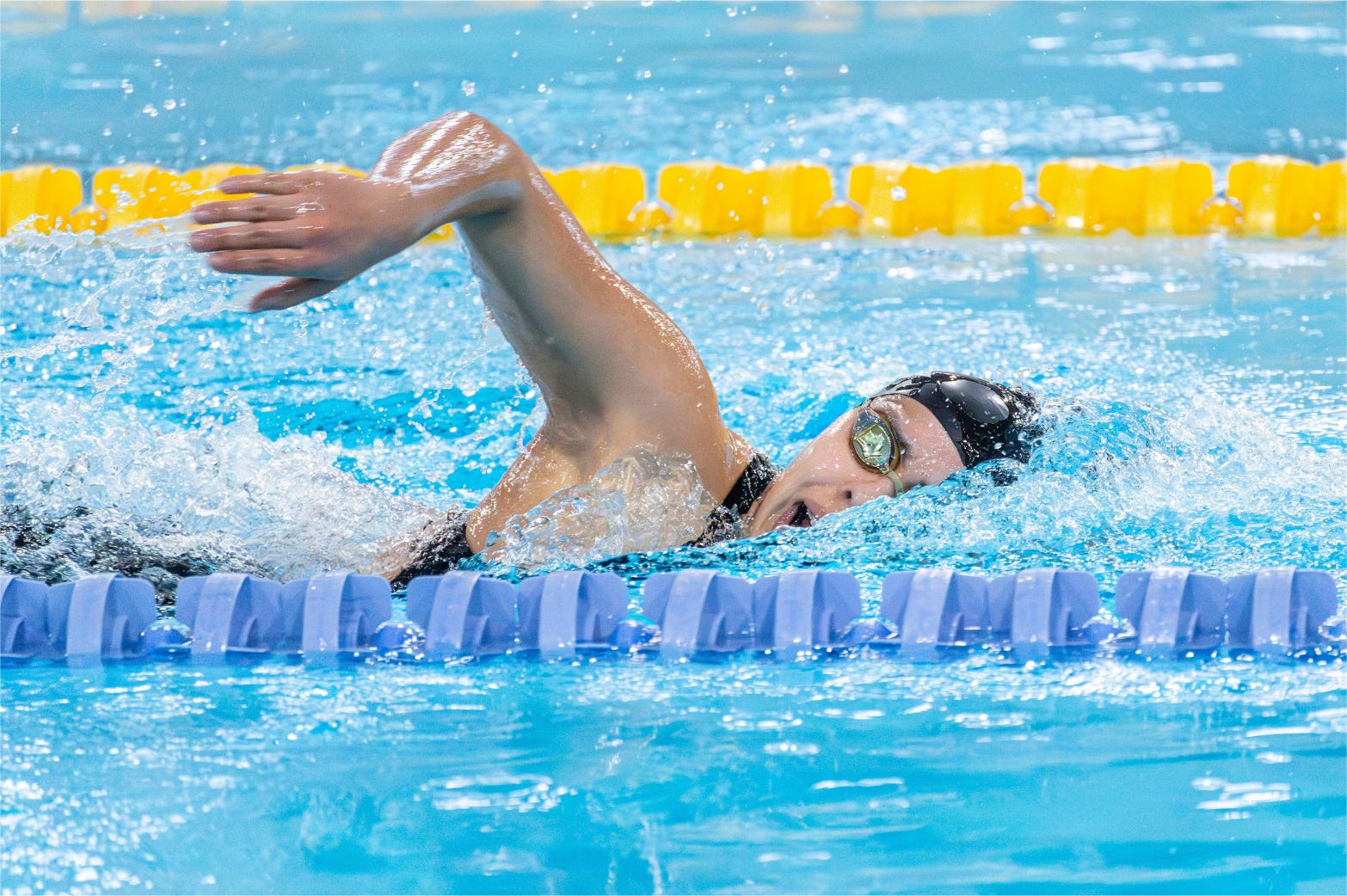
Every coach has seen this.
A swimmer is right where they need to be at the halfway point of the 200. Everything looks great. Then they make the 100 turn and all of a sudden, their stroke shortens and the next 50 drifts off pace. The last 50 slows even more. The swimmer touches the wall with a disappointing time.
The swimmer trained well all season and you know that physically they were ready. The yardage was there. The pace work was there. It just seemed like something changed when it started to hurt.
Here is the unavoidable truth: pain is part of racing. In almost every race, there’s a point where it gets uncomfortable and a swimmer has to decide whether to keep pushing or back off. Oftentimes, that decision is made without the swimmer even fully realizing it.
But a decision made on autopilot is still a decision. The pain is unavoidable; how a swimmer responds to it isn't predetermined. That response is a mindset skill, and like any mindset skill, it can be trained.
In fact, responding to pain is one of the most practical things for coaches to train because as a coach you’re already creating the conditions in practice almost daily. Every hard set, every broken swim, every race-pace effort creates discomfort your swimmers will respond to. This article is about using those moments on purpose.
One important caveat: when I say pain, I mean the discomfort of hard effort — the burning legs, the heavy arms, lungs on fire. Injury is a different conversation, and one for trainers and doctors.
Understanding pain
Here’s something that happens all the time. A swimmer is grinding through a hard set of 100s. The times are slipping, and they’re telling you they’ve got nothing left. Then you call out “last one” — and they swim the fastest 100 of the set.
If they truly had nothing left, that last 100 wouldn’t be possible. They had more. Their brain just wasn’t letting them use it.
Sports scientist Samuele Marcora’s psychobiological model of endurance explains why. Swimmers don’t slow down because they hit a physical limit. They slow down when they hit the most discomfort they’re willing to tolerate. Physical limits are real, but the tolerance limit always comes first.
When a swimmer reaches that tolerance limit depends on how hard the effort feels — and that feeling is produced by the brain, not the muscles. It’s why caffeine and music can improve endurance without adding any physical capacity. They don’t make a swimmer stronger. They make the same effort feel easier.
So there are two ways to make a swimmer faster.
Improve fitness. As a swimmer gets fitter, the same pace feels easier — that’s the work swimmers already do every day.
Improve the ability to tolerate discomfort. Two swimmers with similar fitness can race very differently based on how they respond to discomfort - and that is a skill that can be trained.
If you want to go deeper on the research, two books are worth your time: How Bad Do You Want It? by Matt Fitzgerald and Endure by Alex Hutchinson.
Three skills, one race
The three skills below can be taught to swimmers to help them more effectively respond to discomfort when it shows up. One is for before the race and the others are for during the race. Swimmers should experiment with all three and see what is most effective for them. It’s important to remember there is no one size fits all.
Skill 1: Brace for it
Most swimmers have had at least one race where everything felt almost magically smooth and easy — they accessed that “easy speed” and effortlessly cruised to a PB.
Based on those experiences it’s tempting to walk up to the blocks hoping that this one won’t hurt. But here is the reality - every race is a black box. A swimmer doesn’t know what’s inside until they open it. So instead of thinking “I hope this one doesn’t hurt”, swimmers should try bracing.
Bracing replaces hope with expectation. With bracing, a swimmer expects the race to be hard. They expect it will hurt. And they remind themselves they can handle it. That changes the conversation they have with themselves when it arrives.
Instead of “Oh no, this hurts. I can’t keep it up.” they are saying: “I knew this was coming. I can handle it.” They’re not negotiating with the discomfort, because they already expected it.
This is more than a nice reframe. Research on the psychology of pain describes two ways athletes approach discomfort ahead of time. Suppression is hoping it won’t be as bad as last time. Acceptance is expecting it to hurt and knowing you can handle it. Acceptance makes the discomfort less unpleasant. And the more discomfort a swimmer expects, the more they can tolerate — and the more they can tolerate, the faster they can go.
In practice: Before a hard set, name what’s coming. “This is going to get uncomfortable. That’s the point. Be ready for it.” Swimmers can practice bracing and see how it affects their ability to hold pace when things get hard.
Skill 2: Stop time traveling
Any race longer than a 50 is a pacing challenge. The swimmer has to distribute their effort so they reach the wall having used as much of their capacity as possible.
Think of it like starting with a full tank of gas. The goal is to finish as close to empty as possible. The problem is that the brain isn’t very good at judging how much gas is actually left — especially when it hurts.
That’s when swimmers start time traveling.
They’re at the 300 mark of the 500 and suddenly they’re thinking: I still have 200 left. How am I going to hold this? I’m already dying.
So they back off.
They’ve jumped ahead to a future 50 and decided they won’t have enough left. But they don’t actually know how much they’ll have until they get there. The skill is catching the time travel and coming back to right now. This stroke. This turn. This 25.
Swimmers don’t have to convince themselves it won’t hurt. They just have to stop making decisions based on discomfort they haven’t experienced yet.
In practice: In your next challenging set give swimmers one job: focus on the repeat they’re on - not the next one or the one after that. After the set, ask where their head went when it got hard. Most will recognize the time travel the moment you name it.
Skill 3: Keep it neutral
Bracing takes away the surprise. But even when a swimmer expects the discomfort, the brain still treats it as a warning when it arrives. When a race starts to hurt, the reaction is almost instant: This is horrible. When pain is labeled as bad, a swimmer’s natural reaction is to back off.
The skill is treating pain neutrally instead. A swimmer notices the pain as a sensation in their body, without labeling it as bad or good. A swimmer who reads the discomfort neutrally doesn’t have to fight it or run from it. They notice it and keep pushing.
Evaluating pain neutrally takes practice. Most swimmers won't get it right immediately, but it's worth the reps, because it's what keeps a swimmer from backing off the moment it starts to hurt.
In practice: Before a hard set, tell swimmers what they’re practicing: when the discomfort shows up, treat it as information. Notice when it starts and where they feel it — the way they’d notice a split — without deciding whether it’s good or bad. After the set, ask factual questions: Which repeat did it start on? Where did you feel it first? Asking neutral questions models the neutral read.
Why now
For most teams, December and January are the hardest training blocks of the season. Your swimmers are about to spend weeks in exactly the kind of discomfort these skills are built for.
None of this requires new sets. Start with bracing — it happens before the discomfort and is the easiest to practice — and add the other two as the block goes on.
By the time championship season arrives, your swimmers will have had weeks of reps — not just with the yardage, but with how they respond when it hurts.
Swimmers don’t learn to handle discomfort on race day. They learn it in practice, when someone trains it on purpose.