


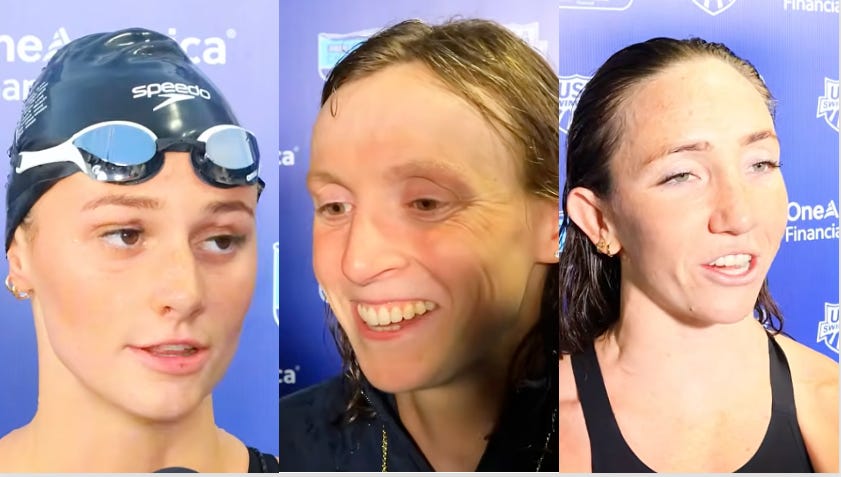
One of my favorite parts of watching high-level championship meets is listening to the swimmers talk after their races. The post-race interviews often reveal far more about mindset than you might expect. One of the most interesting things I consistently notice is that the struggles don’t disappear just because a swimmer is an Olympian, a world record holder or one of the best in the world.
Here are three interviews from last week’s Pan Pacific Championships that caught my attention.
Summer McIntosh: “I was overthinking rather than just racing”
After her 200 freestyle, Summer McIntosh was disappointed with her race. What struck me was that she didn’t blame her training or her preparation - she blamed her mindset.
Specifically, she said:
“I was overthinking rather than just racing.”
She also said she felt like she had more left when she touched the wall.
Despite all the work she’d put in, she said it was ultimately about “doing it on the day and being mentally prepared.”
Katie Ledecky: “You never know what to expect”
Katie Ledecky talked about being “pretty nervous” before her first race of the meet. That caught my attention because we tend to assume that swimmers at her level must have figured this part out by now. Certainly, someone like Katie Ledecky, who has been swimming on an international stage for well over a decade doesn’t get nervous?
However, she openly talked about her nerves and also noted that some of her best 1500s have come in more relaxed environments. She shared that she needed to learn how to pace herself correctly to swim the times she wanted to swim in these kinds of meets.
She also mentioned the meet schedule and specifically that the distance events were being held at 9:15 p.m.—hardly an ideal setup for a 1500.
Lani Pallister: “The most nervous I’ve ever felt”
After her 800 freestyle, Lani Pallister said she was: “the most nervous I’ve ever felt in my entire life.” Again, this wasn’t an age-group swimmer at their first championship meet - this was an elite international swimmer competing at a major championship.
I think there are some important takeaways here for swimmers at every level.
1. Nerves don’t mean you’re not ready.
Swimmers often assume that feeling nervous before a race means something has gone wrong. They start thinking it means that they are not prepared or not confident. They start trying to find ways to get rid of the nerves.
What these interviews show is that even the best swimmers in the world get nervous before important races. Feeling nervous isn’t evidence that you’re not ready – it’s a normal response to racing when something matters to you.
You’ll often hear people say things like “reframe your nerves as excitement”. I’m not a big fan of that advice because a swimmer can’t simply flip a switch and decide that nervousness is now excitement. What they can learn to do is notice the nerves without deciding that they mean something is wrong. Remembering that even world record holders feel nervous can help.
2. Championship swimming rarely happens under ideal conditions.
Katie Ledecky swimming a 1500 at 9:15 p.m. isn’t exactly the situation you’d choose if you could design the perfect conditions for a distance race - but that’s championship swimming.
The schedule isn’t yours to control - neither are the delays, the noise, the warm-up situation, the meet format or a hundred other things that can happen around a race. At some point, every swimmer has to learn how to race when conditions aren’t exactly what they wanted. And as Katie’s comment showed, that’s an ongoing process — you don’t automatically figure it all out once you become elite.
3. Even elite swimmers can get caught in their own heads.
Summer’s comment about overthinking is another reminder that having an excellent race plan doesn’t guarantee you’ll execute it perfectly when the pressure is on.
Sometimes the challenge isn’t knowing what to do - It’s being able to actually do it when the moment arrives. That’s true for an Olympic champion just as it is for a swimmer racing at their first championship meet.
My biggest overall takeaway from these interviews: These are some of the best swimmers in the world, and they’re still figuring out how to handle nerves, uncertainty, imperfect conditions and the tendency to overthink when the stakes are high. They are still noticing things about themselves, adapting, experimenting and figuring out how they want to respond in different situations.
That’s probably one of the most useful things any swimmer can take from watching elite competition. You don’t eventually arrive at some point where mindset is “solved.” There are always new situations, new challenges and new things to learn about how you respond.
Great work! Excellent message!
Great post Rebecca! I especially like your insight about the calming power of noticing nerves vs trying to reframe them as excitement. I believe the reframing strategy becomes at least a little more possible only after you sit with the actual feeling for awhile.