


If you’ve spent time on a championship pool deck, you know the race is only a small part of the meet.
A few weeks ago I introduced the concept of the Championship Meet MapTM. If you missed that article, go back and read it here.
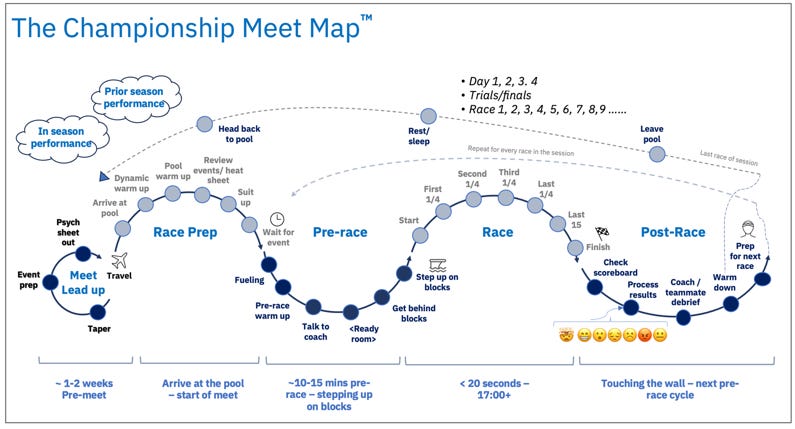
Today, I want to go a level deeper and get more specific about:
Why I map the championship meet this way
How coaches can use this map with swimmers
Why Map out the Whole Experience?
A lot of conversations about mindset in swimming focus on a single moment — the seconds behind the blocks. But any coach or swimmer who has spent time on a championship pool deck knows performance is shaped long before that moment arrives.
A championship meet is not defined by a single moment -- it is a complex environment that swimmers must navigate across many days of racing.
Swimmers know this. Coaches know this.
Nothing at a championship meet happens in isolation. Performance is heavily influenced by everything that happens around the race. But when it’s viewed as a series of isolated moments rather than a connected system, something important gets missed.
When we instead view the championship meet as a complete system we see all the moments that a swimmer must successfully navigate before they get behind the blocks. It becomes clear that much of what happens during a championship meet is predictable.
The sequence of events is predictable — and so are the challenges swimmers face.
As a swimmer navigates through the map, four challenges can reliably show up and derail a swimmer:
👉 fear
👉 pressure
👉 pain
👉 disruption
How challenges show up will vary for each swimmer – but when swimmers have awareness of when and where a challenge is likely to show up for them they can be prepared instead of reacting in real time.
That’s where this becomes practical — challenges don’t exist on their own, they show up in specific moments.
A story from the Spring 2026 edition of SwimSwam illustrates this well.
Italian swimmer Simone Cerasuolo, who won the world title in the men’s 50-meter breaststroke in Singapore, described himself as someone with “little adaptability.” He prefers familiar pools, familiar food — structure and routine are his anchors.
When he qualified for the championship, he felt both excited and concerned about racing far from home.
His primary challenge wasn’t physical — it was disruption.
And importantly, this wasn’t something that showed up behind the blocks. It started before he even arrived — in the travel, the change in environment and the early stages of the meet.
Going through the full championship meet experience far from home was going to be difficult for someone wired this way.
So what allowed him to adapt and perform in this situation?
He identified where he was likely to have a problem — during the meet lead-up and race preparation
He recognized the challenge ahead of time — disruption caused by a new environment
He adjusted his strategy — narrowing his focus and letting go of what he couldn’t control
This is exactly the kind of moment the Championship Meet Map is designed to surface — identifying where a challenge is likely to show up so it can be addressed before it interferes with performance.
How Coaches Can Use This Map With Swimmers
As a coach, you can use the Championship Meet Map with your swimmers to help them better prepare for championship meets. This map is most useful when swimmers don’t just look at it — but use it to prepare for specific moments they will face during a meet.
Here are a few specific actions you can take:
Step 1 - Build Awareness
Share the map with your swimmers and have them compare it to their actual meet experience. Most will recognize these moments immediately.
Step 2 - Identify Patterns
Have each swimmer identify:
2-3 strengths - moments they feel confident in
2-3 “hot spots” - moments that tend to interfere with performance
For each “hot spot” moment, identify the primary challenge that shows up:
👉 fear, pressure, pain, or disruption
Step 3 - Prepare for Key Moments
Before the next meet, have swimmers choose ONE specific hot spot to focus on (e.g., warm up, waiting between events, processing results) and ONE strategy to use.
Keep it simple — the goal is not to fix everything at once.
Step 4 - Reflect and Refine
After the meet, revisit the map with your swimmers:
What happened?
What worked?
What will they adjust next time?
Over time, swimmers learn how to handle these moments more consistently — and begin to build their own approach to racing. That’s where the Championship Meet MapTM and the Formula for OneTM come together.
And that’s really the point – helping swimmers understand the environment they are competing in, where challenges might show up, and developing a personal success formula.
Nice work. Like the step by step map 👌