


In the past several months, I’ve come across a few swim teams in the U.S. that have hired dedicated directors of mental performance to work with their athletes.
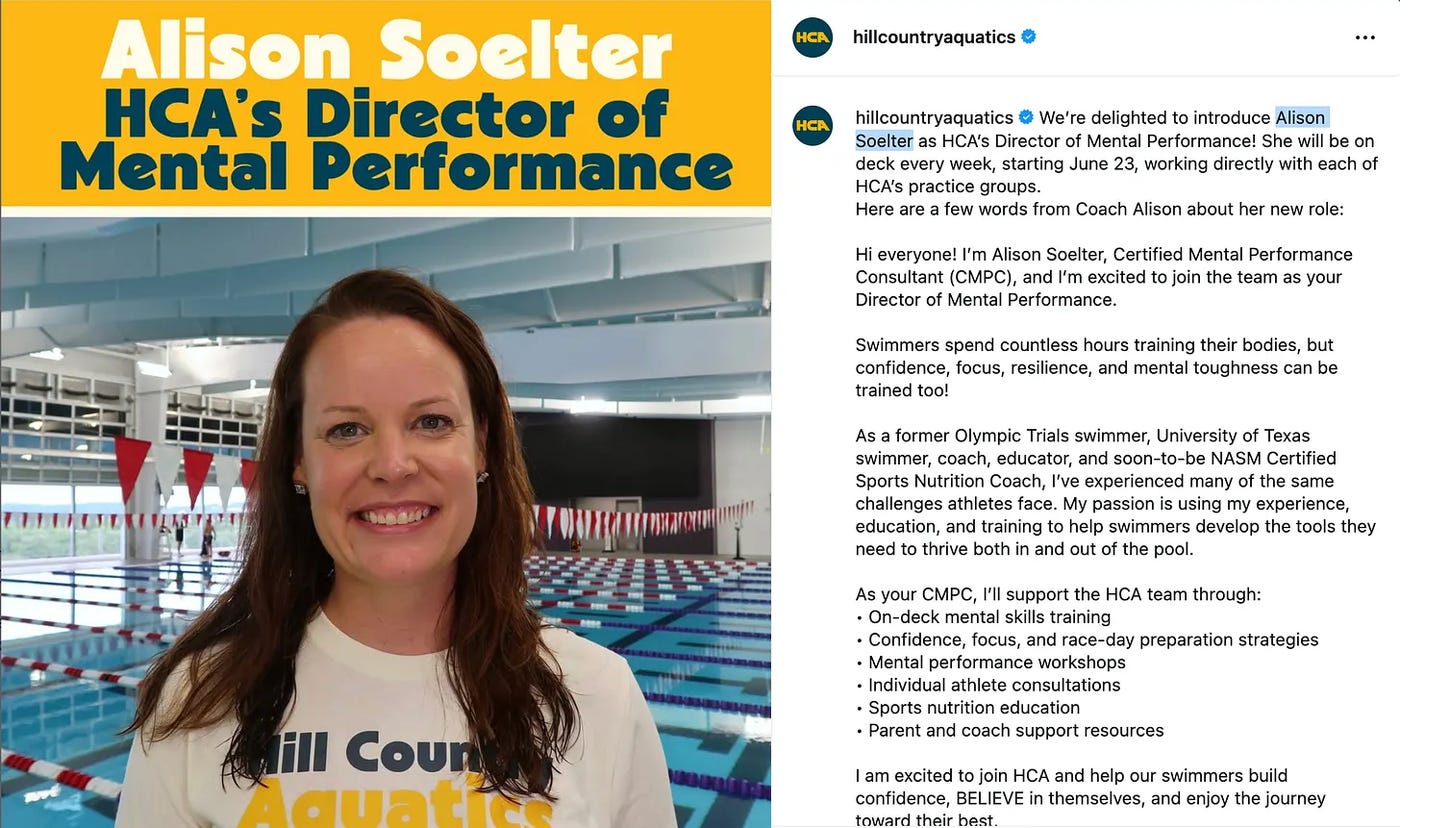
One is Hill Country Aquatics in Austin, Texas, which hired Alison Soelter as its Director of Mental Performance. The Instagram post announcing her role is below.
The other is Lakeside Aquatics Club in Northern Texas, where Jasmine Haas serves as Director of Mental Performance. Jasmine was recently interviewed on the Momentum Coaching Podcast, and one thing that stood out to me was just how unusual her role is in swimming. She talked about hearing of a few programs that are bringing in part-time Certified Mental Performance Consultants or sports psychologists, but as far as she knows, having someone in a full-time role like hers is still very uncommon.
Lakeside is particularly interesting because of the size of the program. With roughly 1,300 swimmers, Jasmine runs a comprehensive program that includes an intern component, where 15 Lakeside athletes are trained and then work with younger swimmers. For a program that large, this creates an opportunity to reach a lot of athletes and build mindset support into the culture of the team from a young age.
I think what these programs are doing is great.
But it also made me think about everyone else.
There are more than 2,800 USA Swimming teams in the country, more than 15,000 high school teams and roughly 1,000 NCAA swimming programs across all divisions. There isn’t good data on how many of these programs provide structured mindset training. Some college programs have access to sports psychologists but the amount of direct support those professionals provide to the swim team can vary. For the overwhelming majority of age-group and high school programs, there is nothing formal at all.
So why don’t more swim teams have dedicated mindset support?
I think it’s a combination of things. Cost is certainly one factor - adding another full time staff member is expensive. Coaches also have full plates already, and building and delivering a structured mindset program takes time that they may not have. Also, even if every team wanted to hire a specialist, there simply aren’t enough mental performance professionals to work with thousands of swim programs.
So we end up with a big divide - a tiny sliver of teams have dedicated professionals working with their athletes, while thousands of other teams have nothing. It would be great if every team could hire a full-time or part time sports psychologist. That’s not realistic for every program but that doesn’t mean those swimmers should get nothing.
Mindset training shouldn’t be feast or famine.
Here is the good news for coaches — there are ways to start making mindset part of the training environment without adding an entirely new program or hiring a dedicated professional.
Here are three places I would start.
1. Start making mindset part of the dialogue.
Coaches talk about the physical side of racing with their swimmers all the time — pacing, technique, race strategy and recovery are all common points of discussion.
It’s much less common for coaches to talk directly about fear, pressure, nerves, disappointment, confidence or the like. When coaches do start talking about these things it brings mindset out of the shadows and makes it something swimmers start to recognize.
A coach can try this:
Before the next big meet, talk openly with your swimmer about fear, nerves and pressure.
Can you recognize what nerves feel like? Is being nervous bad?
What does pressure feel like?
What happens when you start thinking about the outcome?
What happens in your mind when you get behind in a race?
These conversations don’t have to become long lectures. The goal is to make it normal for swimmers to talk about these things and to make these experiences something swimmers can recognize and talk about.
2. Look for opportunities to create pressure or fear in practice — then talk about it.
Coaches create difficult situations in practice all the time: Challenging swimmers with an interval that feels impossible. Having teammates race each other. Pushing a swimmer to lead the lane. Adding an extra round to an already hard set.
Instead of just using the situation as training, use it as an opportunity to help swimmers notice what is going through their mind:
What did you notice?
What were you thinking?
What changed in your body?
Did you want to back off? Rush? Give up? Try harder?
The experience itself becomes the lesson. You’re helping swimmers start to recognize their own responses in situations that resemble what they may experience in competition.
3. Give swimmers something specific to try.
Once you’ve started talking about mindset and helping swimmers recognize what happens when they are challenged, give them something they can actually use.
That might be a breathing technique before a race, a different way to talk to themselves during a difficult set, a way to prepare for high pressure races or a strategy for staying with their race plan when things start to hurt.
Then give them opportunities to use those tools in practice. The goal is to move mindset from something you talk about to something swimmers actually practice. The process of experimentation is important because the goal isn’t for swimmers to memorize a list of mindset tips. It’s for them to gradually develop an understanding of what works for them.
The takeaway
I think the two teams I mentioned are worth paying attention to precisely because they’re doing something that most programs aren’t currently set up to do.
But I don’t think the choice is to hire a director of mental performance or do nothing - - there’s a lot of room in between.
A coach can start talking about mindset. They can use situations that already happen in practice as opportunities to explore it. They can give swimmers opportunities to experiment and learn what works for them.
It doesn’t have to be a perfect program. It doesn’t have to cover everything. It just has to start somewhere. Even small steps toward making mindset part of training are better than leaving it out altogether.