

A few years ago, I made the bold decision to swim the 400 IM at a Masters meet. It had been a long time since I had last swum it.
I dove in and swam a solid 100 fly. Then I turned for the backstroke and quickly realized I had pushed the fly way too hard. The pain was incredible. By the time I got to the breaststroke, I had basically lost my will to live. Somehow, I made it to the wall, struggling all the way. I hung there panting in stunned silence.
What. Just. Happened.
Here’s the thing – I thought I had prepared for the race. I was certainly fit enough, I had visualized how things would go and I thought I was ready. However, what I realized later is that I didn’t have the right tool within reach. When the pain hit, I panicked and started spiraling. I gave in to it and did not deliver the race I’d trained for.
Looking back, the frustrating thing is that I knew what could have helped. If you’d asked me in a calm moment what to do when a race starts to hurt, I would have been able to share some ideas and strategies with you. However, in that moment of panic, everything I knew disappeared.
This is what panic does – when it hits, it becomes very hard to think and act rationally.
This same pattern can happen to any of your swimmers at a championship meet. Stakes are high. Emotions are high. It’s easy to panic and forget what to do.
A Toolbox is Not Enough
Most swimmers will say they have a toolbox of sorts to help them with challenging moments. If they’ve paid attention to mindset at all, they have heard about things like self-talk, visualization and breath work. That’s important -- all swimmers need a toolbox but it’s not enough on its own.
Why? Think about a construction worker. They have a toolbox with every tool they might ever need but that sits in their truck. A tool belt gives them the exact tools they need for a particular job in the exact moment they need it. If they all of a sudden need a hammer, they reach into the belt and grab it.
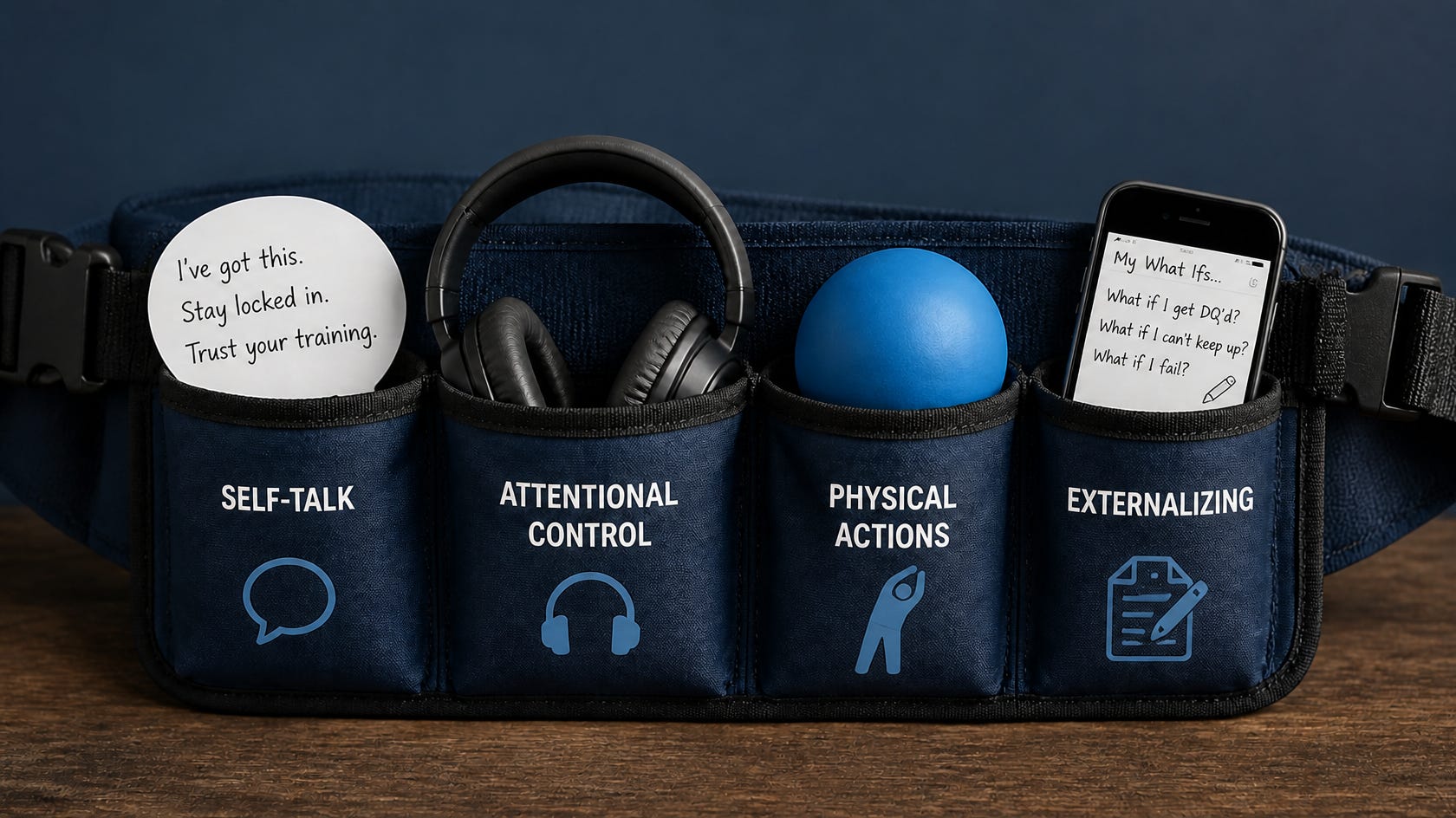
This is what swimmers need too – a mindset tool belt with everything organized and accessible so they can reach for and use the right tool exactly when needed – even in the middle of a 400 IM.
What Goes on the Belt?
In a previous article, I talked about the four challenges of a championship meet – fear, pressure, disruption and discomfort. The tools in the tool belt need to address those challenges.
But how does a swimmer know what tools to put in their belt? First, they need the right number of pockets. Luckily, that’s fairly simple because there are four main categories of tools. Swimmers just need to know which pocket to reach for:
The Four Pockets on the Tool Belt:
Attentional control - where you place your focus
Self-talk - what you say to yourself in your head
Externalizing - getting thoughts out of your head - saying them aloud or writing them down
Physical actions - using your body to influence your mindset
Almost any pocket can work for any challenge. The one that fits depends on the swimmer and the situation.
For example:
Fear → Externalizing
The moment: Between trials and finals, a swimmer can’t eat or rest. Their stomach is in knots thinking about finals.
What they do: They open the notes app on their phone and list every fear swirling in their mind.
Why it works: Research on students before high-stakes exams found that writing down worries for 10 minutes helped the most anxious students perform as well as everyone else.
Pressure → Physical actions
The moment: In the ready room, a swimmer’s shoulders are tight and stiff, and they can’t stop thinking, “I have to win.”
What they do: They take a small ball from their parka and squeeze it in their left hand.
Why it works: It sounds odd, but research on athletes under pressure found that a left-hand squeeze helped right-handed athletes avoid choking under pressure.
Disruption → Attentional control
The moment: A swimmer steps up on the blocks, and the timing system goes down. They catch themselves staring at the scoreboard, panicking.
What they do: They step back, put their headphones back on, and run through their race cues.
Why it works: Research suggests that when something unexpected happens, anxiety pulls attention to what doesn’t matter. Race cues pull it back to what does.
Discomfort → Self-talk
The moment: Halfway through the 200 fly, a swimmer feels like they’re dying. They turn for the third 50 and wonder if they can make the last 100.
What they do: They go to the self-talk phrases they picked and practiced before the meet.
Why it works: In one study, cyclists who practiced their own motivational phrases for two weeks rode 18% longer before exhaustion, and the effort felt easier.
These are examples, not prescriptions. It’s a matter of a swimmer learning and practicing to see what tools work best for them in different situations. These are the tools the swimmer wants on their tool belt.
Train like a Pilot
Organizing the tools is half of it. The other half is practice.
In Make It Stick, a book about how learning works, the authors describe a pilot’s training. He spent 18 days in a classroom, 10 hours a day, learning the plane’s systems. He also had to know around 80 “memory action items,” things to do immediately, without hesitation, when something unexpected happens in flight.
The classroom hours didn’t make those actions automatic. The flight simulator did. That’s where he practiced pulling them out under realistic conditions, again and again, until there was no hesitation left.
That was my problem in the 400 IM. I’d done the theoretical part. I’d just never practiced reaching for a tool in the water.
Coaches, your in-season meets are the flight simulator.
Every meet before championships brings the real challenges in smaller doses: the fear before a big race, the pressure of a cut, a delay behind the blocks, a back half that hurts. That’s where swimmers can practice reaching for a tool while the stakes are lower, so the reach is automatic by the time the meet that matters arrives.
Before a meet, ask your swimmers which pocket they’ll reach for and what tool will be there. After it, ask whether they reached, whether the tool was there and what they might do differently next time.
Back to that 400 IM
I have not been brave enough to try another 400 IM but if I swam that race today, I’d reach for self-talk first, and attentional control to get through the back half without panicking.
The pain would still be there. But I’d know exactly where to reach.
Coaches, if you’d like to explore the role mindset plays in your team’s performance, I’m offering a complimentary Championship Performance Audit.
References
Brown, P. C., Roediger, H. L., III, & McDaniel, M. A. (2014). Make it stick: The science of successful learning. Belknap Press of Harvard University Press.
Ramirez, G., & Beilock, S. L. (2011). Writing about testing worries boosts exam performance in the classroom. Science, 331(6014), 211–213.
Beckmann, J., Gröpel, P., & Ehrlenspiel, F. (2013). Preventing motor skill failure through hemisphere-specific priming: Cases from choking under pressure. Journal of Experimental Psychology: General, 142(3), 679–691.
Eysenck, M. W., Derakshan, N., Santos, R., & Calvo, M. G. (2007). Anxiety and cognitive performance: Attentional control theory. Emotion, 7(2), 336–353.
Blanchfield, A. W., Hardy, J., de Morree, H. M., Staiano, W., & Marcora, S. M. (2014). Talking yourself out of exhaustion: The effects of self-talk on endurance performance. Medicine & Science in Sports & Exercise, 46(5), 998–1007.