


I am a huge fan of listening to interviews with elite swimmers because I think there are almost always interesting insights to take away. Last week I wrote about post race Pan Pac interviews with Summer McIntosh, Katie Ledecky and Lani Pallister. This week, I came across a SwimSwam podcast with Carson Foster who was also reflecting on his Pan Pacs swims.
Check out the interview here:
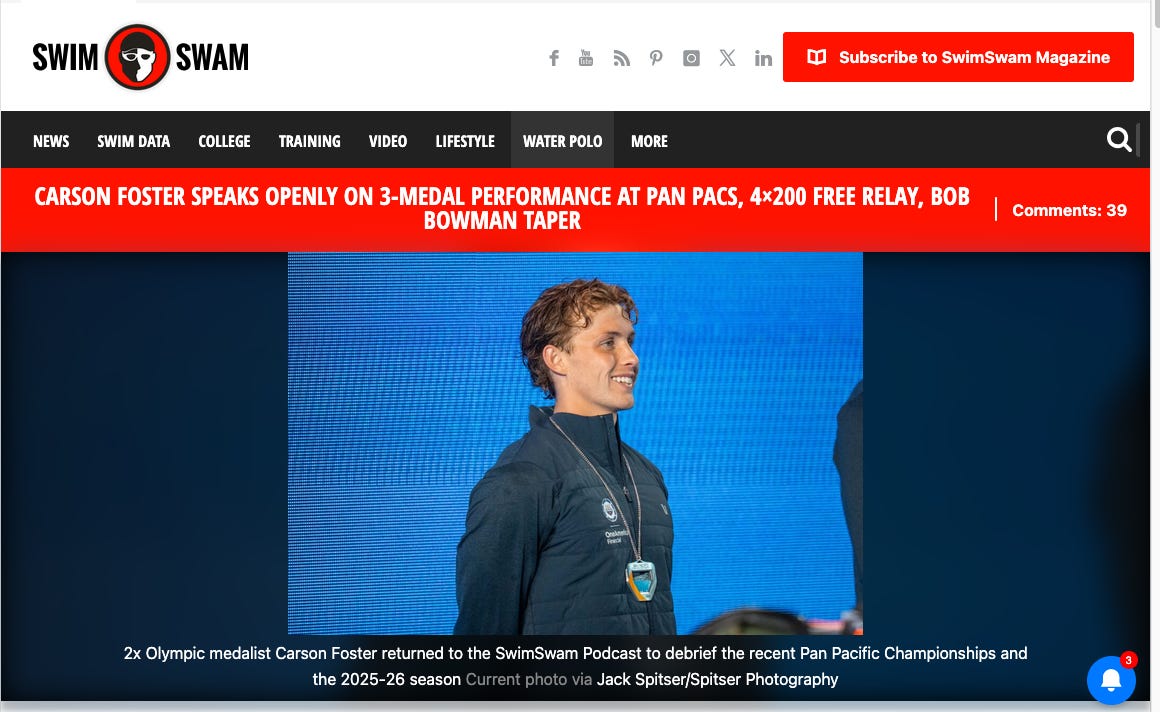
In the past, Carson has talked about using brainspotting, a targeted psychotherapy treatment that uses specific eye positions to help people access and process emotional pain and stress, to get better at performing in high pressure moments.
What he talked about in the Pan Pacs interview was something much simpler.
In his 200 fly prelims swim at Pan Pacs, Carson said he had trouble staying in his own lane (go to 28:40 in the interview to listen). He went to his coach, Bob Bowman and said:
“… I can’t say in my own lane. I keep watching and when I see someone else coming up I just start spinning and I get freaked out and my whole body starts to hurt”
Bob’s solution? Not some complicated mindset routine. Nothing complicated at all. He simply gave Carson some things to think about for each 50 and told him to pretend like he was doing 4x50s in practice the way Bob told him to do it.
The result? According to Carson, the race “just went by like that”. He tied his best time and said he felt like he “unlocked something there.”
In the 400 IM, Carson reported falling into the same trap during prelims - looking around at the other swimmers. At the 150 turn, he looked over and saw Rex Maurer and Bobby Finke right next to him and knowing their reputation as closers he started spiraling. He again went to Bob and talked about how he could not stop looking around.
Once again, Bob gave him things to work on including the second 50 of breaststroke and the first 50 of freestyle. Carson followed directions and just like in the 200 fly final he found focusing on the race and not his competitors changed everything for him.
So what are the lessons here?
Elite swimmers aren’t immune to the four challenges.
If you have not read my article on the Four Challenges, please check it out. What Carson describes in this interview is the 3rd challenge - disruption. With disruption, a swimmer’s attention get pulled outward onto things happening around them. Carson’s description of not being able to stay in his own lane is a perfect example of this challenge at work. Being an Olympian doesn’t make him immune to it.
The first step to addressing a challenge is naming it
The key step that Carson took was noticing the challenge, naming it and then talking to his coach about it. Then, together with Bob, he developed a plan to address it. Notice that he didn’t just get frustrated and throw up his hands after his race — he actually noticed what was going on with his mindset. Doing that then allowed him to come up with the specific plan with Bob’s help.
Sometimes the best solutions are the simple ones
This one is so important. Sometimes it seems like mindset work is complicated or too hard. It does not have to be. Bob’s solution for Carson was simply to focus on specific aspects of his race and pretend he was at practice. Could it get any simpler than that?
It’s not one and done
Carson was candid that even after he “unlocked” something in his 200 fly final he still struggled with the same thing during his 400 IM prelims swim the next day. It took another not so great swim, and another conversation with Bob to remember what he had to do in order to stay in his own lane. I am sure he will have to continue to work on this in the future. In fact, Carson himself said this is something he has struggled with his whole career.
Conclusion
Mindset training does not have to be complicated. It does not always require a lengthy routine, a complicated visualization, or some elaborate mental strategy.
Often it starts with something much simpler: noticing what is getting in your way, naming it, and finding one thing you can do to get yourself back on track.
For Carson, it was four 50s.
Simple? Yes.
Easy? Not necessarily.
And that may be the difference.
The goal of mindset training isn’t to make championship racing easy. It is to give swimmers simple tools they can use when racing gets hard.