


I spent 24 years at IBM and eventually became an executive. But here is something that might surprise you — I never wrote a line of code. I never took a computer science class. In fact, I was a psychology major in college.
So how does someone like me become an executive at one of the most well-known tech companies in the world? I didn’t build the technology. Across a lot of different roles, my work kept coming back to the same thing: helping people understand what the technology could do and how to put it to work.
It might not be obvious how that applies to swimming. But it gave me three insights that have shaped how I approach mindset training and how I’ve built the Swim Mindset Collective.
Insight #1: Looking at something as a process reveals where performance can leak out.
During my time at IBM, I was frequently asked to analyze processes and systems, identify relevant performance metrics, and determine how they could be improved. Through this work, I learned that processes can have performance leaks: points where a step isn’t working as well as it could, affecting the overall outcome. For example, a manual step could introduce errors and affect the overall accuracy of a process.
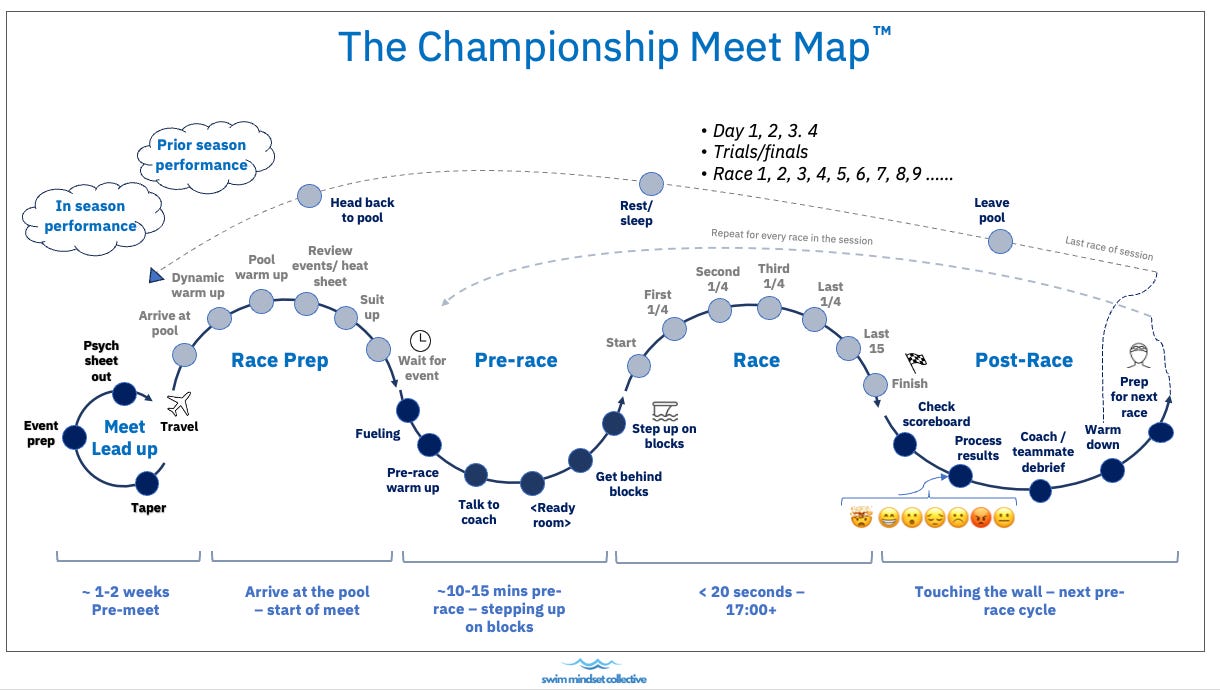
When I look at competitive swimming, I see championship meets in much the same way. A championship meet follows a defined process, and I created the Championship Meet Map™ to lay out the entire experience in detail.
Just like in any process, performance leaks can show up in championship meets. For example, fear can leave a swimmer’s stomach in knots, making it difficult to fuel properly. Pressure might cause a swimmer to lose sight of their race cues when they dive in. Overthinking between prelims and finals can make it difficult for a swimmer to rest properly.
Identifying performance leaks improves outcomes, whether in a corporate setting or at a championship meet. The full Championship Meet Map can look overwhelming —there are dozens of steps a swimmer goes through day after day. However, it becomes simpler when a swimmer focuses their attention only on the specific dots where performance is leaking. Addressing those leaks improves how they navigate the meet—and ultimately how they perform.
Insight #2: The right framework makes an idea easier to understand and apply.
At IBM, it wasn’t enough to explain the technology. I had to make its value clear and give clients a way to understand what it meant for them and what they could do with it. Often that meant developing frameworks that helped a client understand exactly what IBM was offering and how they could implement it within their own environment. The framework provided the scaffolding the client needed to take a high-level concept and make it into something practical and actionable.
The same principle applies to mindset in swimming. There are plenty of good ideas out there, but understanding an idea and knowing how to apply it are two different things. A swimmer might understand what pressure feels like and know it’s important to manage it. But what do they actually do when they’re standing behind the blocks? Telling a swimmer that “pressure is a privilege” doesn’t answer that question.
That’s why I’ve built frameworks into the Swim Mindset Collective that help swimmers turn mindset concepts into something they can recognize, remember, and use. For example, in The Swimmer’s Toolbox, I give swimmers four categories of tools for working with The Four Challenges, with multiple tools in each category. When a swimmer recognizes a challenge, they can easily remember the four categories, pick a tool, and use it, which makes it much easier to put concepts into practice.
Insight #3: People learn what works by trying it for themselves.
During my time at IBM, we commonly ran pilot projects with clients. Why? Because they gave clients an opportunity to test our technology in their own environment and see whether it actually worked the way we said it would. A pilot allowed them to prove the concept for themselves and build support internally.
Mindset strategies need a pilot too. It’s one thing to give swimmers a strategy and explain how it’s supposed to work. It’s another to have them try it in practice or an early season meet, see how it works for them, and decide whether it’s something they want to keep using. An early season meet is a swimmer’s pilot.
Just like my corporate clients at IBM, swimmers need the opportunity to experiment with different strategies, figure out what works for them, and discard what doesn’t. Over time, they can build a set of approaches they understand, trust, and know how to use when they need them.
Putting it all together
My experience at IBM shaped how I approach mindset training: looking at championship meets as a process, building frameworks that make mindset concepts practical, and giving swimmers the opportunity to test strategies and discover what works for them.
To the coaches reading this: you know how to train swimmers. I bring a different set of tools to help swimmers navigate the challenges that arise at championship meets.
If you’d like to explore where mindset challenges may be affecting your team’s championship performance, I’m offering a free Championship Performance Audit. Click below to learn more.